 Free shipping over $70 US/CAN


You’ve seen the tornado. That visible spiral inside the chamber – the one that looks like it belongs in a physics demonstration more than a glass pipe. It’s not decorative. It’s the whole point.
Here’s what’s actually happening.
The Venturi Effect – Why the Tornado Exists
In 1797, Giovanni Battista Venturi figured out something interesting: when a fluid – air, water, gas – passes through a constricted channel, it accelerates. Velocity goes up. Pressure goes down. The surrounding air rushes in to fill that low-pressure zone.
That’s the Venturi effect. It’s why carburetors work. It’s why aircraft wings generate lift. It’s the same principle that powers every Helix piece.
The tornado you see in a Helix pipe is Venturi cooling made visible.
Three precision micro-ports are machined into the glass chamber at specific angles. When you draw through the pipe, air accelerates through the constriction. The three inlets pull ambient air in at an angle – and those three incoming streams collide in a spiral. That spiral is the tornado. It’s centrifugal force, rotating the draw and mixing cooler ambient air into a stream that was, a moment earlier, up to 700 degrees F.
By the time it reaches your mouthpiece, the temperature has dropped to approximately 100 degrees F.
That’s not filtration. That’s physics.
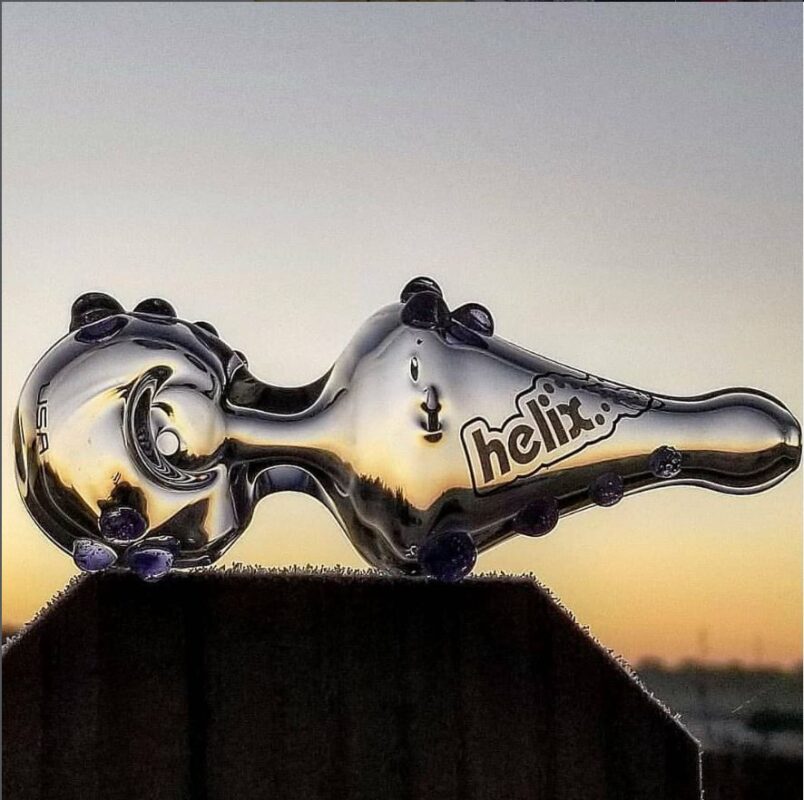
Why the Spiral Shape Matters
A straight draw through a pipe moves hot air from point A to point B. Fast. Direct. Unchanged.
The helix spiral changes the geometry of the path. The rotating column of air has more surface area than a straight column of the same volume. More surface area means more contact with the cooler glass chamber walls. More contact means more heat transfer.
The tornado isn’t just a party trick – it’s the mechanism that makes the cooling work.
The Original Patent
The Venturi cooling system in every Helix piece was patented in 2007 by William Menzies Jr., in Moody, Texas. Menzies apprenticed under Bob Snodgrass – the glassblower credited with pioneering modern borosilicate art glass – and spent years developing the three-port geometry that produces the spiral.
The patent covers the specific inlet configuration. The angles. The relationship between bore size, port diameter, and chamber length. Getting those measurements wrong produces airflow turbulence instead of a clean spiral. Getting them right produces the tornado.
From 2009 to 2024, the Helix technology was licensed to Grav Labs – one of the largest glass brands in the country. Grav stopped manufacturing Helix in late 2024.
Menzies never stopped. American Helix has been in continuous production for 19 years.
Which Pieces Show the Tornado Most Clearly
Every piece in the American Helix lineup uses the same three-port Venturi geometry. The tornado is present in all of them. But the spiral is most visible in pieces with clear borosilicate chambers and longer draw paths.
The Helix Classic Handpipe – in Micro, Mini, and OG sizes – gives you a clear view of the full spiral column. The longer the piece, the longer the visible tornado before it dissipates.
The Helix Steamroller series lets you watch the spiral travel the full length of the chamber before it reaches the mouthpiece. End-loading design means an unobstructed view of the column from carb to mouthpiece.
The Helix Solo Chillum is the most compact expression of the same geometry – the tornado is shorter, but the cooling effect is proportionally the same.
The Temperature Numbers
Up to 700 degrees F in. Approximately 100 degrees F out.
That range accounts for variations in material, temperature, and draw technique. The physics is consistent. The three-port Venturi chamber drops temperature regardless of the source – the mechanism doesn’t care what it’s cooling. It’s moving air moving air through a geometry that produces centrifugal cooling.
The tornado is what that looks like when you watch it happen.
American Helix is the original source of Helix Venturi glass – engineered in Moody, Texas since 2007. Every piece ships in one business day. See the full collection at americanhelix.com/shop/
Frequently Asked Questions
What creates the tornado in a Helix pipe?
The tornado is created by the Venturi effect, where air accelerates through a constricted chamber and mixes with incoming air through three micro-ports, forming a spiral.
How does the Venturi effect cool the smoke?
The Venturi effect pulls cooler ambient air into the hot stream, reducing temperature significantly through airflow mixing and pressure changes.
Why is the spiral shape important in a Helix pipe?
The spiral increases surface area, allowing more heat transfer with the glass chamber, which enhances cooling efficiency.
What temperature reduction does a Helix pipe achieve?
The system reduces temperature from up to 700°F down to approximately 100°F at the mouthpiece.
Which Helix pipes show the tornado most clearly?
Clear borosilicate glass models like the Helix Classic Handpipe and Steamroller series show the tornado most visibly.
Blog
What Is a Helix Pipe? The Complete Guide to Patented Venturi Cooling
A Helix pipe is a borosilicate glass pipe with a patented Venturi cooling system built into the chamber. Three micro-ports,

Blog
What Creates the Helix Pipe’s Tornado? The Physics Behind the Swirl
You’ve seen the tornado. That visible spiral inside the chamber – the one that looks like it belongs in a